
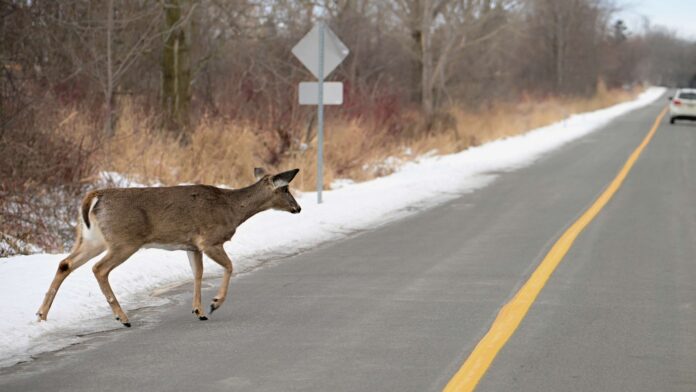

Road Safety at Work reports that May and June are among the highest-risk months for wildlife collisions on B.C. roads due to changing behaviour by both drivers and animals.
ICBC reports an average of more than 12,000 animal-related incidents and 952 people injured annually over the last five years. In the Southern Interior, including the Kamloops area and Okanagan regions, the annual average is 5,232 incidents over the past five years.
“The numbers tend to spike at this time of year,” Tracy Acres, spokesperson for Road Safety at Work, said. “Deer account for most collisions in May, and elk in June, as wildlife movement increases sharply.”
She added that deer and elk are more active at dawn and dusk, crossing roads unpredictably as they search for food, move to new habitat or care for young.
“Roads look clearer and the weather is better so drivers may not be as alert to the hazards,” Acres added. “At the same time, wildlife activity is peaking. And that combination raises the risk of collisions.”
In a statement, the provincial driving initiative said people who drive as part of their job are especially exposed to the risks, noting that hundreds of thousands of B.C. employees drive as part of their job, either full time, part time or occasionally.
“They’re on the road more, often at dawn or dusk, and that puts them directly in the window of time when wildlife is most active,” Acres said. “Work drivers also frequently travel rural routes where wildlife is common.”
Road Safety at Work is reminding drivers of ways to prevent collisions:
- Wear a seatbelt.
- Slow down and be alert in areas marked with wildlife warning signs and near parks, forested areas and waterways.
- Scan roadsides for wildlife continuously, especially in low-light conditions.
- Be prepared for multiple animals, not just one.
- Avoid swerving suddenly, which can lead to losing control of the vehicle.
If you do collide with wildlife, “focus first on protecting people, then dealing with the scene and reporting the incident,” Acres advised.
- Check yourself and passengers for injuries. Call 911 if anyone is injured.
- Turn on your vehicle’s hazard lights. Stay well off the road if you have to get out of the vehicle.
- Do not approach an injured animal. Call the B.C. Conservation Officer Service at 1-877-952-7277. If it is dead, contact the road maintenance contractor through DriveBC.ca’s “Report a Highway Problem” page.
- Contact your employer if you are driving for work and follow their instructions.